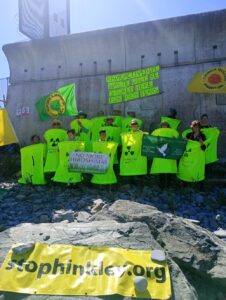
On the 81st Anniversary of the first nuclear bomb devastating Hiroshima, Stop Hinkley alongside the Bridgwater Peace Group, highlighted the dangers of nuclear power and how the issue of highly radioactive nuclear waste was still not being considered within the business of nuclear. We need to remember all those who died from the nuclear bombing of Japan in 1945.
There are still over 12,000 nuclear weapons in existence across the globe and nuclear weapons, like nuclear power, create radioactive nuclear waste.
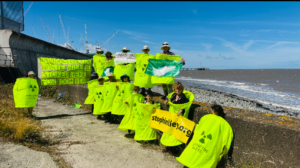
With the proposed Hinkley Point C (HPC) reactors, highly radioactive spent fuel will be stored for over one hundred years on the eroding coastline at Hinkley Point, just a few metres above sea level. Unlike the Hinkley A and B reactors, where the radioactive spent fuel was transported relatively quickly to Sellafield, the very hot waste of the HPC station will stay in Somerset on site, making Hinkley the Sellafield of the South.
The sea wall defences of Hinkley A and B have, since their initial construction, been breached by the sea on a regular basis, showing that there was not enough forethought for sea defences 70 years ago. Extra gabions have been washed away in the storms in front of the A and B stations and have had to be replaced and made higher. With the predicted sea level rises and future extreme weather events, HPC will be facing worse problems but with the waste having to remain on site, a combination of circumstances that will create a risk no one wants to own. When the reactor stops generating, EDF will hand over the waste responsibility to the British government and the British tax payer as it sits precariously on the HPC site.
Stop Hinkley and Bridgwater Peace Group wanted to show on this significant date how close to the sea the radioactive waste will be stored. Their concerns are that with global warming and sea level rise, combined with storm surges. This location will be too vulnerable to store long term the radioactive waste. To date there is no safe disposal of the waste. Building nuclear power stations is extremely expensive and it is also extremely costly to the tax payer to keep the waste safe forever. After the nuclear energy from the reactor has been used for just 60 years, the waste will be a high risk and a sizeable expense for the public for thousands of years.
As we plan the uncertain future of water and food provision, we should be asking: “How are we going to pay for the storage and keep the nuclear waste safe?”